22/10/2026 16:09
Pieces or Boxes? Checking Telegram Translations Before Quoting at Cambodian Fastener Shops

A Telegram enquiry can sound perfectly clear after translation and still leave a fastener shop unsure what to pack. Does “two boxes” mean two retail packs or two shipping cartons? Does “same size” refer to the bolt diameter, its length or the packaging shown in yesterday’s promotion? For Cambodian businesses handling Khmer and other languages, translation can help staff understand a question, but the buying details still need confirmation. This workflow connects a useful promotional post to a careful enquiry process: identify the item, check the translated meaning, confirm the selling unit and only then prepare a quote.
1. Begin with the ambiguity your promotion creates
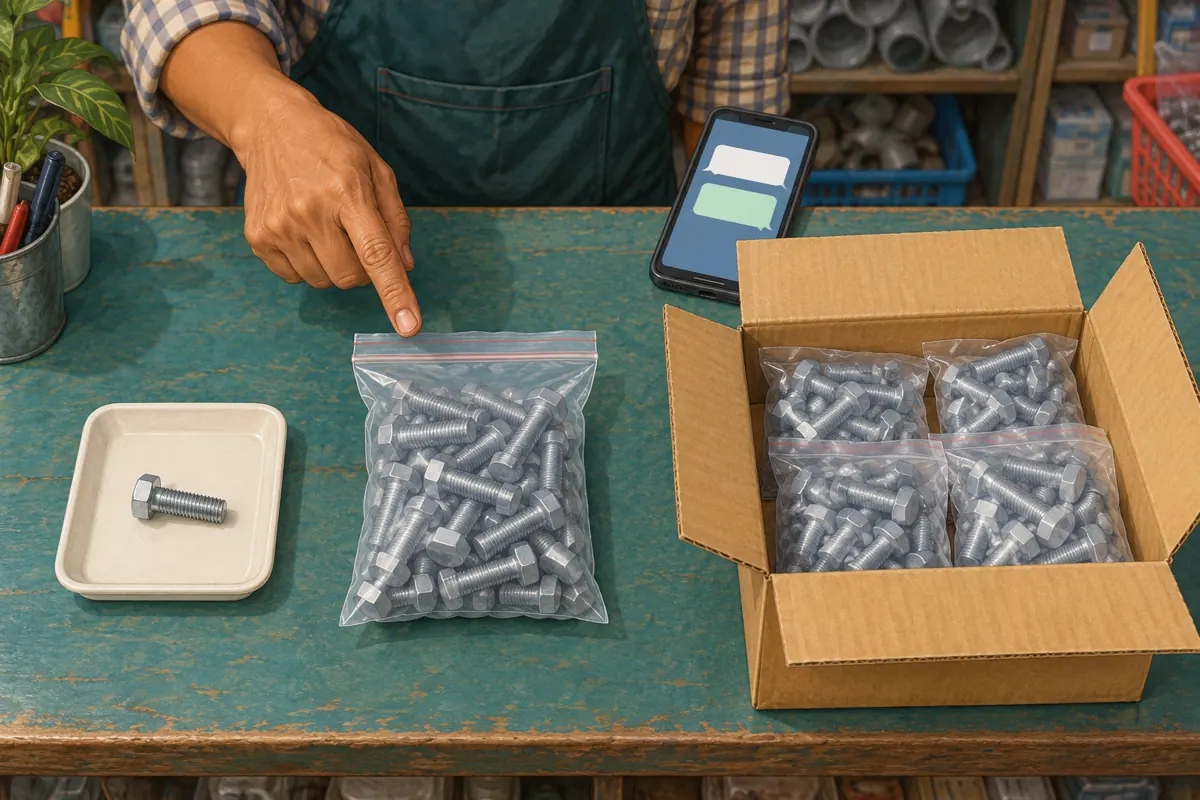
Imagine a hypothetical fastener wholesaler in Phnom Penh posting a photograph of loose bolts beside several bags and a larger carton. A buyer replies in another language asking for “three packs of the long ones.” The translated sentence identifies a general intention, but it does not establish a product code, a precise length or a pack quantity. Staff should treat it as an enquiry awaiting clarification.
Before promoting that photograph, decide which purchasing question it should answer. If the purpose is to show available packaging, identify each selling unit in the caption. If it compares bolt lengths, give each pictured product a stable reference. A useful call to action asks buyers to send the product reference, required quantity and preferred packing unit. That gives translation something concrete to work with instead of forcing staff to interpret an attractive but ambiguous image.
2. Set up translation on the phone staff actually use
Telegram’s official message-translation guide explains that enabling Translation under Settings > Language adds a Translate option when selecting a message. Languages marked as already understood can be excluded, hiding that option for those messages. Check these settings on the device used at the counter. Test with a harmless sample enquiry before relying on the feature during a busy sales period.
Telegram also documents entire-chat translation for Premium users, accessed through the Translate bar. Individual-message translation and whole-chat translation are different conveniences; neither confirms that a technical term has been interpreted correctly. Available languages can depend on the phone’s operating system, according to Telegram’s guide. Check the required language pair directly rather than promising every customer automatic support. If the option is missing or the result is unclear, ask for a simpler written question or involve a colleague who understands the language.
3. Keep the original wording beside the working interpretation
Read the original message and its surrounding conversation before acting on the translation. A short answer such as “the other one” only makes sense when staff know which photograph or earlier question it refers to. Keep a reference to that exchange in the shop’s enquiry notes. Record the interpretation as provisional until the buyer confirms the important details.
Use three short fields: what the customer supplied, what staff currently understand and what remains unresolved. In the hypothetical enquiry, those fields might read “three packs of the long ones,” “possibly the longer bolt in the comparison photo” and “product reference and pieces per pack unknown.” This prevents the next shift from treating a guess as an instruction. Avoid rewriting the customer’s message into a polished order description too early; polished wording can conceal precisely the uncertainty that needs attention.
4. Separate product identity from packaging quantity
Confirm the product first. Ask for the reference shown in the post, or send a clear photograph of the proposed item and ask the buyer to identify it. Preserve product codes exactly when copying them into replies. Do not translate a code as though it were a word, and do not silently replace an unfamiliar abbreviation with a different specification.
Then establish the selling unit. A piece, bag, box and carton should each mean something defined for that item. In a hypothetical example, the shop might pack 50 pieces in one bag. If the buyer asks for two bags, repeat “two bags containing 50 pieces each, 100 pieces total” and request confirmation. These are illustrative quantities, not a standard packing rule. Use the shop’s actual checked contents. Also clarify whether nuts and washers are included, because a translated request for a “set” may leave that unresolved.
5. Use photographs to resolve one question at a time
When a term remains ambiguous, send a focused comparison rather than another crowded shelf photograph. Show the selected item separately, with its reference visible in the accompanying message. If length is the question, show the relevant measurement clearly. If packing is the question, photograph the loose item, the sale pack and the outer carton separately. Ask which of those units the buyer means.
A photograph helps identify visible features, but it does not establish every technical property. Do not infer material grade, thread specification or suitability from appearance alone. Check the product records and ask for the required specification where necessary. For a hypothetical customer choosing between two similar bolts, staff could ask for the product code first and the required length second. One focused question is easier to answer accurately than a paragraph mixing dimensions, quantity, delivery, payment and alternatives.
6. Repeat the complete proposal before quoting
Once the uncertainties are resolved, send a compact confirmation containing the product reference, relevant specification, number of pieces, packaging arrangement and any included accessories. Add the proposed collection or delivery date using an explicit calendar date. If quoting a price, name the currency and state whether it applies to a piece, a pack or the entire quantity.
Ask the buyer to confirm that proposal before staff reserve or pack goods under the shop’s normal process. A reply to an earlier photograph may not confirm a later quantity change. If the buyer corrects one field, issue an updated summary so both sides are working from the same proposal. Avoid treating an emoji or a general expression of thanks as acceptance when the message contains several unresolved choices. The purpose is a shared understanding of the order, not merely a conversation that appears to have ended.
7. Keep sensitive details out of unnecessary translation
Telegram’s Privacy Policy, section 8.4, says text selected for translation may be shared with Google or Microsoft to obtain the translated version. That makes selective translation useful when the only question concerns a product name or packing instruction. Staff should understand this processing before enabling whole-chat translation for conversations containing customer information.
Keep product clarification separate from payment evidence, identity documents and detailed delivery information where practical. If another staff member needs to help with a term, share the minimum relevant wording through the shop’s approved process. A product-only example is usually enough to discuss whether “box” refers to a retail pack or an outer carton. Never turn a real customer exchange into public promotional content simply because the translation makes an interesting example. Create an explicitly hypothetical example instead, with invented details unrelated to an identifiable buyer.

8. Put SMM panel decisions after the enquiry test
Before considering a Telegram service on smm-best.com, test whether a new visitor can identify the item and send a usable enquiry. Have a colleague read the public post without your explanation, choose a packing unit and draft a question. If they cannot tell what is being sold, revise the post before assigning more promotional budget to it.
One supplied catalogue entry is “Telegram Members ~ [ 30 Days Auto Views From Members ] 400 Post/Days”. Its title presents a member service with an automatic-view component, but the brief supplies no explanatory description. Treat those words as catalogue wording requiring clarification, not verified delivery evidence. Nothing provided establishes Cambodian audience origin, language ability, buying interest or translation support. Purchased engagement is not evidence of genuine interest, sales, ad delivery or Cambodian users. If the business objective is understandable local enquiries, a catalogue count alone cannot demonstrate that objective has been met.
9. Track clarification outcomes separately from audience counts
Maintain a modest enquiry log with the originating post, requested product, unclear term, clarification sent and final outcome. Useful outcomes include specification confirmed, quotation requested, waiting for buyer response and order accepted under the shop’s usual process. Keep these distinct from channel membership and post-view figures. An increase in a visible counter does not explain whether buyers understood the offer.
Review recurring misunderstandings to improve the next post. If several genuine enquiries require staff to explain the packing unit, move that information earlier in the caption and show the pack clearly. If product identity is usually clear but collection arrangements are not, improve the collection instructions. These decisions should follow the content of actual enquiries. Do not claim that a translation feature or a panel service caused sales simply because both were used during the same period.
10. Avoid shortcuts that turn uncertainty into an order
Common mistakes include assuming fluent translated wording is accurate, accepting “same as before” without checking the earlier product, and copying a supplier’s pack size into a retail offer without checking current stock. Another is translating a translation repeatedly until it sounds natural. That can change the meaning further while making the result seem more convincing. Return to the original wording and resolve the missing fact directly.
Give staff a simple decision rule. If the uncertainty concerns conversational tone, answer politely and continue. If it changes product identity, quantity, currency, included parts or timing, stop the quote and clarify that field. If the required technical meaning remains unresolved, involve a knowledgeable colleague or request an exact specification. Promotion can bring someone to the conversation; the shop’s confirmation process determines whether staff have enough information to act responsibly.

Frequently asked questions
Do we need Telegram Premium to translate a single enquiry?
Telegram’s official documentation distinguishes individual-message translation, available to all users, from Premium whole-chat translation. Check Translation in the app’s language settings and test the required language on the device. Premium convenience does not remove the need to verify product codes, packing units and technical meaning.
What if the translated message says “box” but the photo shows several types of packaging?
Send a focused photograph or description of each available selling unit and ask which one the buyer means. State the actual contents of the selected unit, then repeat the total quantity. Do not choose a meaning based on which interpretation produces the larger order.
Should we replace our Khmer promotional captions with English to make translation easier?
Choose the public caption language for the intended readers. A Khmer caption can still use stable product codes, clearly stated quantities and familiar units. Add a human-reviewed second-language explanation when it serves your customers. Keep the underlying product and packaging details consistent across versions.
Can a Telegram member service bring customers who speak the language we support?
The supplied catalogue entry does not establish language ability, location or purchasing intent. Ask for documented service details, but do not interpret member or view counts as qualified Cambodian enquiries. Assess genuine conversations by whether the buyer identifies a relevant need and confirms enough detail for a useful response.
How can a small shop start without creating too much paperwork?
Choose one frequently promoted product and write a reusable confirmation format covering its code, specification, packing unit and quantity. Test it with a colleague, then adapt it to real enquiries. Keep brief notes only on unresolved facts and meaningful outcomes, so the process helps the counter team rather than delaying every reply.
Explore the current service catalogue, create an account, or ask a specific question through support tickets.
- Telegram: Reactions, Spoilers, Translation and QR Codes — Message Translation
- Telegram: Profile Photo Maker, Translating Entire Chats, Emoji Categories and More
- Telegram Privacy Policy — Section 8.4, Translation of Chats, Channels and Specific Messages
Prepared with AI assistance. Illustrations explain the workflow and do not represent customer results.