20/10/2026 10:31
Which Month Was That Tile Posted? Telegram’s Media Calendar for Cambodian Tile Shops

A customer remembers a patterned tile from your Telegram channel but cannot remember its name. They think you posted it before their renovation started. Your staff scroll through photographs, find something similar and prepare to promote it again. The missing step is proving what that photograph represents today. For Cambodian tile retailers, Telegram’s media calendar can help recover an earlier product reference. A separate stock check must establish whether the shop can still supply it. This workflow connects those tasks without confusing an old photograph, a current offer and a social media view count.
1. Start with the customer’s memory
Ask for the smallest useful set of clues: roughly when the customer saw the photo, which channel or conversation contained it, and one distinctive visual feature. A border pattern, speckled surface or photograph beside a doorway can be more useful than a vague colour name. If the customer has a screenshot, ask them to remove unrelated personal information before sending it.
Write a short search note before browsing. In a hypothetical enquiry, that might be: pale patterned floor tile, photographed near the showroom entrance, probably posted during the month before the customer began renovating. Keep the remembered month provisional. The customer may remember when they received a forwarded image rather than when your shop originally posted it.
Also establish their purpose. Replacing a broken tile requires a different level of identification from choosing a similar style for a new room. That distinction determines what your eventual reply can responsibly promise.
2. Use the calendar to narrow the archive
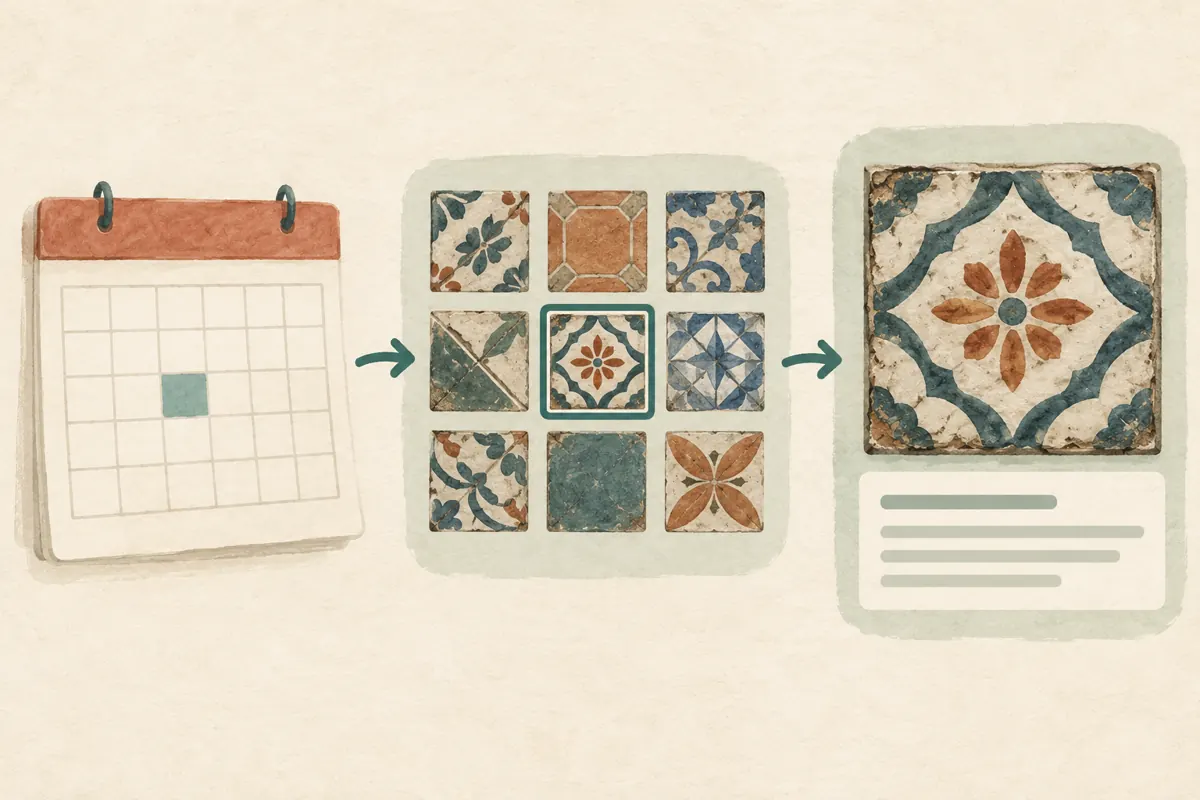
Telegram documents a shared-media view accessible through the chat header. Its date bar opens a calendar with media previews, allowing you to select a date and browse media from that period. The media view also supports filtering photos and videos. These are navigation tools for finding a candidate image. See Telegram’s official guide: [Shared Media and Calendar View](https://telegram.org/blog/shared-media-scrolling-calendar-join-requests-and-more).
Open the relevant shop channel, enter its media area and move toward the remembered period. If you are looking for a still photograph, use the photo filter where available. Inspect nearby dates before expanding the search to another month. App layouts can differ, so confirm the controls on the device your staff actually use.
Once you find a likely photograph, examine its associated message and caption. Stop treating the thumbnail as sufficient evidence. The surrounding information may reveal that the picture showed an alternative colour, a supplier sample or an earlier collection.
3. Keep posting dates separate from stock dates
The date used to locate a message does not establish when its pictured goods arrived, when the photo was taken or whether that batch remains available. A shop might post an older showroom photograph during a later promotion. Staff might also reuse a sample image when a different shipment arrives. Record the message date as a publishing reference, then verify the commercial details independently.
Create a compact internal note containing the original message reference, any visible product code, the caption’s description and the unanswered questions. Mark missing information explicitly. Writing batch unknown is more useful than silently assuming that two similar photographs show the same stock.
Avoid ambiguous numerical dates in the handover. Write the month in words and distinguish posted on from stock checked on. When another employee takes over the enquiry, they should immediately understand which date helps find the photograph and which date supports an availability statement.
4. Confirm the product beyond its appearance
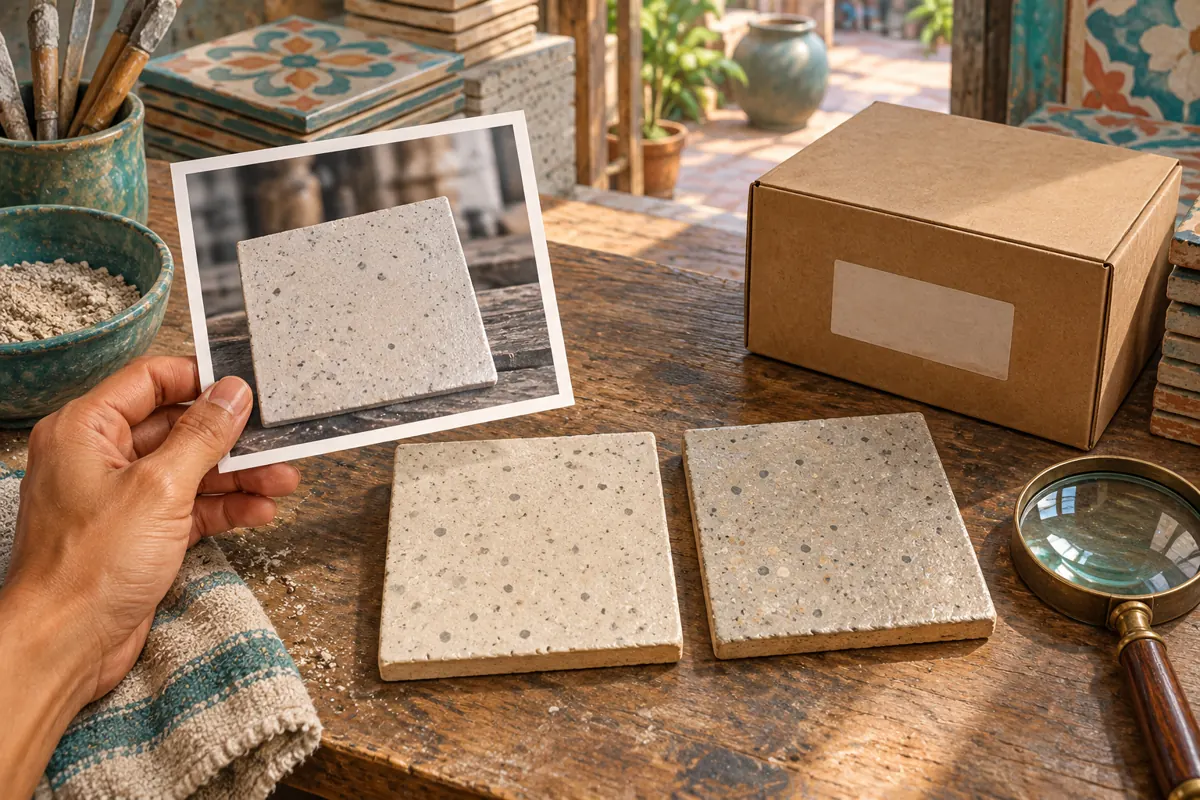
Compare the candidate photo with your product records and physical samples. Useful identifiers include the supplier’s product code, stated dimensions, finish and any batch or shade information available on the packaging. A remembered colour is a starting point, but lighting, camera processing and the customer’s screen can make different tiles appear similar.
For a replacement enquiry, ask whether the customer has an original carton label, spare tile or purchase record. Request only the relevant part of a document. They do not need to send a full invoice containing their address or unrelated purchases just to identify a product.
Give the match a clear status: confirmed product reference, possible visual match or unresolved. Even a confirmed model reference does not automatically confirm a colour match with previously installed tiles. If the available evidence remains weak, offer a physical comparison rather than presenting the closest photograph as an exact replacement.
5. Check supply before turning the discovery into promotion
Finding an attractive older image can tempt a shop to reuse it immediately. First ask the stock holder to check the relevant cartons or current inventory record. Establish whether the item is available, reserved, discontinued or awaiting confirmation. A sample on the showroom wall is not evidence that sufficient stock is ready for collection.
Check the practical details that affect a Cambodian buyer’s next step: where the stock is held, whether inspection is possible, and whether the shop can arrange the requested pickup or delivery. Confirm prices and selling units through the shop’s normal process. An earlier caption may describe conditions that no longer apply.
Choose the response from the evidence. Confirmed current stock can support a fresh availability post. A sold-out item may still support a clearly labelled design-reference post. Unresolved identification calls for a private follow-up, with promotion paused until the essential facts are known.
6. Build a fresh post around the useful distinction
A recovered image becomes useful promotion when it answers a current customer question. Explain whether the post concerns the same product, a similar alternative or an archived design. Put that distinction near the beginning. Readers should not need to reach the final sentence to discover that the pictured batch is unavailable.
Pair the reference image with a current photograph when the comparison matters. Keep the lighting reasonably consistent and describe any known difference in finish or appearance. For a Khmer-speaking audience, have a staff member check the customer-facing wording in Khmer while preserving genuine product codes exactly. Do not translate a code into a nickname that breaks identification.
Use a specific invitation to enquire: send the product code, required quantity and whether you need a replacement match or a new installation. Ask for detailed delivery information privately when it becomes necessary. This gives staff a useful starting point without exposing customer addresses in public discussion.
7. Walk through a hypothetical tile enquiry
Consider a hypothetical Phnom Penh tile shop whose customer remembers a pale floral design posted before a kitchen renovation. The employee searches the likely month through the media calendar and finds two photographs. One shows a glossy sample; the other shows a matte version. Opening the associated captions reveals different product references.
The customer confirms the matte version using a cropped carton-label photograph. The stock holder then checks the warehouse and finds that the original batch is unavailable. A similar design remains, but its shade differs. The employee replies with the identified reference, explains the availability limitation and offers an in-person comparison.
For the next promotion, the shop prepares an educational comparison showing how to identify the two finishes. It labels the original image as an archive reference and photographs the available alternative separately. The useful result is a more accurate conversation. This hypothetical example does not imply a sale, a conversion improvement or any measured campaign performance.
8. Decide whether an SMM panel service has a relevant role
Complete identification and stock verification before evaluating a panel service. A service cannot recover a missing product code, confirm a batch or make an obsolete offer accurate. For an unresolved replacement enquiry, better photography or a staff stock check may address the problem more directly than any engagement purchase.
One public catalogue example supplied for smm-best.com is "Telegram - Premium views - [ MIXED COUNTRY ]". Its title places it in the Telegram views category, but the supplied description is empty. That information does not establish delivery mechanics, Cambodian audience origin, genuine interest or suitability for your particular post. Confirm current requirements and applicable platform rules before considering it.
If a service remains under consideration, record the exact approved post and the business question separately from the service-delivery record. Purchased engagement is not evidence of Cambodian users, sales, ad delivery or genuine demand. Do not present a larger counter as proof that local homeowners prefer the tile.
9. Measure whether customers can identify the right tile
Choose observations tied to the original problem. Record whether an enquiry includes a usable product reference, whether staff still need to request basic identification, and whether the customer understands the difference between an archived image and current stock. Keep unresolved matches visible so they can inform the next photograph or explanation.
Telegram explains that channel view counts are approximate and include views of forwarded copies. A counter therefore should not be read as a list of unique prospective buyers. See the official [Channels FAQ](https://telegram.org/faq_channels). Your enquiry log and stock records provide different information from the public view total.
During a review, separate what happened from what caused it. If customers begin sending clearer carton-label photos after your explanatory post, record that observation. Without a sound comparison, do not claim that a panel order caused the change. Retain actual questions as evidence of information needs, while removing personal details from editorial notes.
10. Avoid shortcuts that create another round of confusion
The first common mistake is selecting the nearest-looking thumbnail and skipping its caption. The second is treating the customer’s remembered month as certain. Search neighbouring dates and confirm the product reference before quoting. Set a practical stopping point: when browsing no longer produces useful clues, ask for a label or physical sample instead of guessing.
Another mistake is recycling the complete old promotion, including its price, availability and pickup wording. Reuse the useful visual only after reviewing what it implies. Label historical material clearly and write current terms from verified records. Where an earlier public post needs clarification, make the correction understandable to someone who sees that post alone.
Finally, make the next enquiry easier. Add a stable product reference to future captions and retain the link between photographs and stock records. Assign someone to review promotional accuracy when stock changes. A searchable archive becomes valuable when the shop can explain what each recovered image means today.

Frequently asked questions
What if the customer remembers only a season or renovation milestone?
Use that memory to define an initial search window, then expand gradually. Ask whether they saw the image before ordering materials, during installation or in a later forwarded message. If the search remains broad, a distinctive pattern or cropped packaging label may narrow it faster than further scrolling.
Does finding the original photograph prove that the same tile is available?
No. It establishes a historical reference that still needs checking against product and stock records. Confirm the model and available batch information, then check current supply. For replacement work, explain any uncertainty about shade or finish and offer a physical comparison where possible.
Should a sold-out tile photograph be removed from every future post?
It can remain useful as a clearly identified archive example, especially when teaching customers how to recognise a pattern or finish. Avoid presenting it as a current offer. If you show an available alternative, identify that alternative separately and explain the relevant differences.
Can the supplied Telegram views service bring Cambodian tile buyers?
The supplied listing does not establish that outcome. Its description is empty, and its title cannot prove audience origin or purchasing intent. Judge genuine enquiries through their content and your normal sales process. Do not use purchased engagement as evidence that Cambodian customers want a particular design.
What should staff do when the calendar controls are not obvious?
Check the media area in the official Telegram app version being used and consult Telegram’s feature guidance. Avoid inventing a button sequence for another device. Staff can still narrow the task using the customer’s clues and product records while confirming the available navigation controls.
Explore the current service catalogue, create an account, or ask a specific question through support tickets.
- Telegram: Hyper-Speed Scrolling and Calendar View for Shared Media, Join Requests, Global Chat Themes on iOS and More
- Telegram Channels FAQ
Prepared with AI assistance. Illustrations explain the workflow and do not represent customer results.